
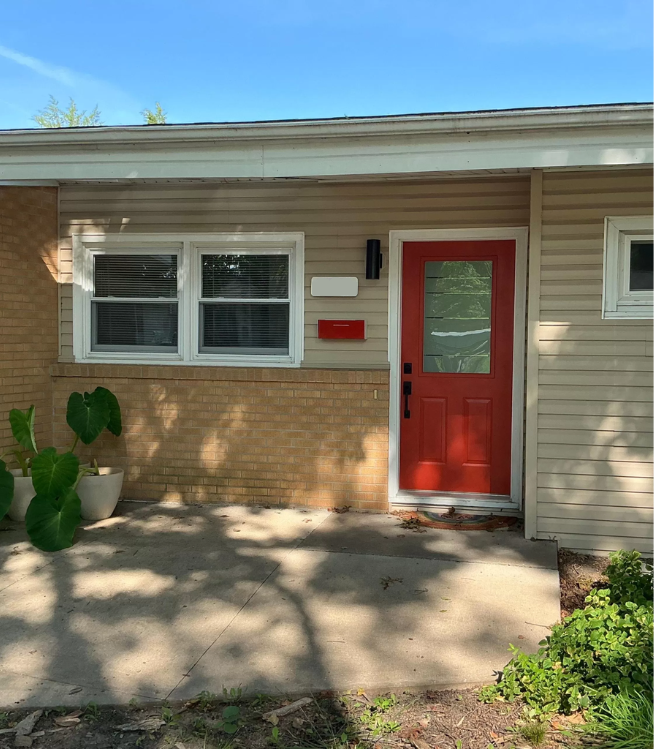
Gary and Ximena’s home.
“I feel that if my wife and I can do this, it’s within reach of a lot of people…” — Gary Freymiller
CUB Board Member Gary Freymiller hopes his experience electrifying his home can help others choose the best path to cleaner, more efficient heating and cooling.
“I feel that if my wife and I can do this, it’s within reach of a lot of people. We’re not wealthy people,” Gary said of himself and his wife, Ximena Barreto. “My experience has been that you can electrify your life on a modest budget and come out okay financially.”
Gary, who works in the clean energy industry, and Ximena, a graphic artist and photographer, moved from a condominium in St. Louis to a 1957 ranch house with gas heat and water heating in Macomb in February 2022.
“I had read the book Electrify, by Saul Griffith, so I had a plan to get rid of the gas service and go all electric,” Gary said.
His reason? Environmental benefit. The engineer, who works to mitigate methane emissions from landfills, wanted to lower his home’s emissions by eliminating gas, a fossil fuel. People who “cut the gas pipe” also say they’re concerned about the health consequences of burning gas in a home. (One study linked gas stove emissions to asthma and cancer.)
Gary has another reason to like his super-efficient appliances, combined with solar panels: “Saving money is great too.”
It’s vital that people interested in going all-electric first make their home as energy efficient as possible, so they can match their home’s heating and cooling needs with the right heat pump system.
“We encourage people to do an energy audit and take other steps to improve their home’s weatherization as a first step to doing electrification right,” said Zoe Huspen, CUB’s Carbon Free Buildings Coordinator. “The most successful electrification stories often include people weatherizing first and eventually adding solar panels.”
When they moved into their 65-year-old, 1,000 square-foot home, Gary and Ximena knew their place was in need of appliance replacements, beyond the heating system. While that cost money upfront, Gary knew those non-gas replacements would be competitive in the long run.
Here’s the Electrification Timeline Gary and Ximena Followed
- August 2022: Installed a heat pump water heater. “We turned off our gas service and had the meter removed as soon as the water heater was installed,” Gary said. “So there was no turning back after this.”
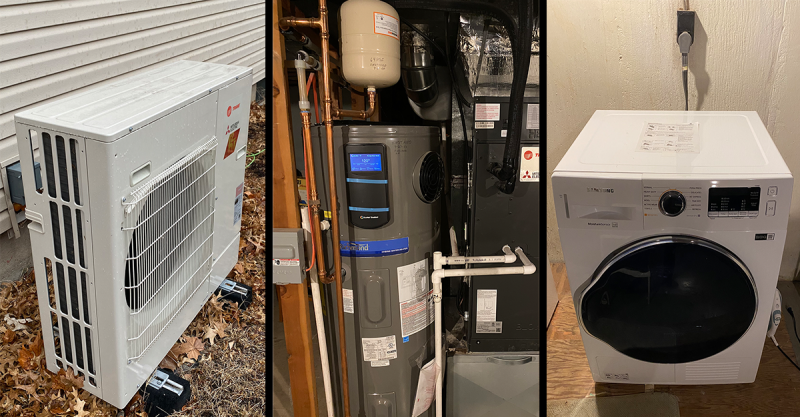
From left to right, their heat pump, heat pump water heater, and heat pump clothes dryer.
- September 2022: Installed an air-source whole-house heat pump. His system has a back-up resistance heating element, like what’s used to heat a toaster, which is used when outside temperatures get extremely low. While the backup still avoids using gas, it uses a lot more electricity than the heat pump does. But Gary’s next step–installing solar panels–helps make up for that inefficiency.
- December 2022: Started using a heat pump clothes dryer. Gary likes that a heat pump dryer doesn’t require poking a hole in the wall to vent the heat, as is the case with traditional dryers. It takes about twice as long to dry clothes, which may be more challenging for a larger family, but it’s no problem for him and his wife, Gary said.
- Spring 2023: Solar panels installed. August 2023: Panels energized. The panels, which produce around 8 Megawatt-hours (MWh) per year, working with the collection of high-efficiency electric appliances, have sparked major savings on his electric bill. Gary pays Ameren Illinois about $16 per month for having the service–and in most months he has no charge for energy usage. “I think we’re saving quite a bit,” he said. “We’re generating more than we’re using.” In those months where the panels over-produce, he sells the energy back to the grid through a process called “net metering” that gives him bill credits.
- They also drive two EVs: a 2014 Nissan Leaf and a 2021 Leaf. The 2014 Leaf is used only for making the rounds in Macomb. The 2021 Leaf has a larger battery capacity and can be used for longer trips. For convenience they often take Amtrak to Chicago or rent a car, two or three times per year, when unsure of EV charging availability. Gary likes the savings on gasoline and avoided maintenance: “I’m happy to avoid those annoying oil changes you’re supposed to do every three months, or 3,000 miles or whatever,” said Gary, who considers it “a blessing” not to take his EVs into the shop.
Lessons Learned
Lesson 1: Big savings–in most months
Thanks to his solar panels, Gary’s Ameren electric bill is reduced to about $16, just for the service, in most months of the year. Plus, he’s happy to say goodbye to a gas bill. (After Ameren received its fourth rate hike since 2018, the gas utility now hits customers with a monthly service charge of more than $24, before using any gas.) However, in January and February, the solar panels don’t generate as much energy due to the shorter days and snow sometimes covering the panels. Couple this with increased electric usage due to greater heating demand and more frequent car charging (caused by the use of snow tires and heating the cars), and the result is electric bills around $200 during these winter months. Still, Gary said he’s saving money overall, because his bills are so low the rest of the year. “I imagine most other people in Illinois are paying $200 or more in January and February for heating their houses and fueling their vehicles,” he said.
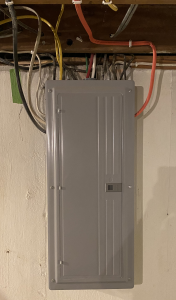
The electrical service panel.
Lesson 2: The switch will likely call for electrical upgrades, which come at a cost.
When Gary bought his electric heat pump water heater, “I thought I could just plug it into the wall.” Instead, it sat in a shipping box in their garage for six months while they waited for an electrician to upgrade the electric service panel from 100 amps to 200 amps and install a new 220-volt circuit. The bill for that upgrade was about $1,000. His Level 2 Electric Vehicle Charger also required a new circuit installation. Together, the new circuit for his EV with the Level 2 Charger cost around $600, but he’s making up for it in other savings.
Lesson 3: Finding a good HVAC contractor is essential.
Gary says it was critical to find a Heating, Ventilation and Air Conditioning (HVAC) contractor who was experienced in this type of conversion–you don’t want to be their first experience at switching from a gas furnace to a heat pump. After checking out the three or four contractors in Macomb, the couple eventually found one about 38 miles away: the Comfort Man–Scranton Heating and Cooling in Mount Sterling.
Lesson 4: Take advantage of incentives.
Always ask your contractor and do your own research on incentives that are available for electrification. Gary said federal and state incentives for solar panels and EVs “were very helpful” in reducing the cost of those upgrades. The end of the Inflation Reduction Act incentives was a big blow to people wanting to modernize their home heating systems, but there still are state incentives available. And, Gary points out, the efficient appliances he bought without the help of incentives were still really good deals: “We didn’t use rebates, and they were pretty easy to pay for themselves.”
Gary says of his home’s switch from gas to electricity: “No regrets at all.” Sure, maybe he got a “few funny looks” from contractors who didn’t get it, but the process was “no stress.”
“My wife and I made the conversion in a matter of months,” he said. “This wouldn’t have been possible 10 years ago, but today it’s really no big deal.”
