
CUB advocates for consumers in many different ways and venues, from holding utility bill clinics throughout Illinois, to making legal arguments in the highest court of the land.
Earlier this June, the Supreme Court ruled on Federal Communications Commission (FCC) v. AT&T, a landmark decision that affirmed federal agencies’ authority to enforce the law and hold big corporations accountable. CUB, represented by Earthjustice, filed an amicus brief in the case, recognizing the importance of shielding consumers, not just locally, but at the highest levels of government.
The legal filing was part of CUB’s larger fight to protect the independence and enforcement powers of the Federal Energy Regulatory Commission (FERC)—more on that soon—and to ensure a bulwark against exploitation of consumers by powerful companies, including one accused of “brazen” fraud.
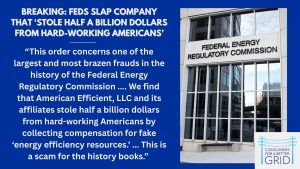
From CUB’s post on X in April 2026, after federal regulators found that American Efficient had collected $400 million+ in “unjust profits” through market manipulation and misled the electricity grid operators that serve Illinois—PJM and MISO. Click on the image to see the post, and the story by Utility Dive.
American Efficient: alleged fraudster goes after FERC independence and enforcement power
The story of our involvement at the Supreme Court begins with a separate, but related legal battle to protect ratepayers. In 2024 following a multi-year investigation, FERC ordered American Efficient, a company that claims to promote energy efficiency, to respond to FERC enforcement’s allegations regarding what the Commission later described as “one of the largest and most brazen fraud schemes” in the agency’s history. In 2026, the Commission ultimately found that American Efficient collected more than $400 million in “unjust profits” through market manipulation and misled the electricity grid operators that serve Illinois—PJM Interconnection (PJM) and the Midwest Independent System Operator (MISO).
Under American Efficient’s business model, they reportedly pay big box stores and appliance manufacturers to sell more efficient products. PJM and MISO, in turn, have paid American Efficient on the assumption that efficiency improvements reduce consumer costs across the grid. But FERC says American Efficient never proved that customers were using less power. According to FERC, American Efficient simply bought sales data on energy efficient appliances from big box stores like Home Depot and then submitted those sales to PJM and MISO, effectively making a profit off of consumer receipts.
But in January 2025, American Efficient shot back, challenging FERC’s order in a federal lawsuit, American Efficient v. FERC, seeking to evade financial penalties and challenge FERC’s enforcement powers. If successful, American Efficient could get away with not only stealing millions from the pockets of everyday consumers, but also potentially undermining federal safeguards for ratepayers. That’s when CUB, represented by Earthjustice, decided to intervene in the case.
“Energy efficiency is a legitimate tool to reduce prices and improve grid reliability. What makes American Efficient’s fraud so detestable is that it used energy efficiency simply as a pretext for higher profits off the backs of everyday consumers,” said Clara Summers, director of CUB’s Consumers for a Better Grid campaign. “To make matters worse, American Efficient is going after FERC’s bedrock independence and enforcement powers. CUB had to step in.”
Mixed decisions at the US Supreme Court
American Efficient’s case rests on two pillars.The first claim is that by assessing penalties before a jury trial, FERC had violated their Seventh Amendment rights. However, American Efficient has the right to request a jury trial and would not have to pay any penalties until a jury finding. The second claim is that American Efficient’s rights were somehow violated because the President is unable to fire FERC Commissioners without cause. Both claims are silly, but the consequences of losing FERC enforcement powers and independence are dire. Since similar claims were being considered at the Supreme Court, the American Efficient case was put on hold pending decisions in those cases.
Those decisions came in June, and bring us back to the amicus brief we filed at the Supreme Court. In Federal Communications Commission (FCC) v. AT&T, telecommunications corporations challenged regulators’ power to issue penalties, invoking the same Seventh Amendment argument. CUB saw this case as another important arena to advocate for regulatory powers and consumer protections, one that related directly to the American Efficient case. On June 4, the Supreme Court voted 8-1 that the regulatory penalty assessment process used by the FCC–and similar to the one used by FERC–does not violate the Seventh Amendment.
A few weeks later the Supreme Court issued a decision that contradicted decades of legal precedent and could threaten FERC’s basic independence. In Trump v. Slaughter, a 6-3 decision, the High Court ruled that the President has unrestricted authority to dismiss leaders of executive agencies. While the Court made an exception for the Federal Reserve in a separate case, the Slaughter ruling could apply to many other formerly independent agencies, including FERC (as American Efficient has argued). The result is that the heads of those agencies now have to worry that they may be fired for disagreeing with the President, even if it’s a matter of punishing alleged fraudsters like American Efficient.
What’s next?
While SCOTUS ruled in favor of the FCC earlier in June–a decision that undermined American Efficient’s claim against FERC’s enforcement powers–the decision the Court issued in Trump v. Slaughter cast the Commission’s removal protections into doubt. What the Slaughter decision means for American Efficient v. FERC is still unsettled—but its potential to undermine the independence of FERC is a real danger, one that could be felt by consumers everywhere.
With the Supreme Court decisions behind us, the fate of the American Efficient case rests in the hands of a federal District Court. However, even with the Slaughter decision, federal agencies are still required to follow their founding laws, and the courts are required to ensure that agencies are doing so. American Efficient and corporate fraudsters generally will have an uphill battle proving their case, since FERC is required by law to ensure that electricity rates are “just and reasonable.” Regardless of the outcome, CUB will continue to fight for consumers, whether it’s at the state, RTO, or even Supreme Court level. We deserve a clean, affordable energy system that isn’t freighted with abuse by corporate grifters—or weakened regulatory powers.
This article was written as part of our Consumers for a Better Grid Campaign, dedicated to advocating for consumer interests at the largest power grid in the nation. Learn more and sign up for updates here.
