
More than 9 out of 10 community-negotiated power offers in Ameren Illinois territory are currently money-losers, while most of the offers in Commonwealth Edison territory are either about the same as or better than the utility supply price, according to a CUB review of data from the state of Illinois’ electric choice website.
Illinois law allows municipalities and counties to enter into electric supply agreements on behalf of residential and small-business utility customers living within their borders. This is called municipal aggregation. Normally, if you do not proactively switch, your electricity will by default be supplied by your utility — ComEd or Ameren. But with aggregation, local governments can negotiate the price of power from a different supplier, and switch you automatically. (Read CUB’s fact sheet to learn more.)
If you are part of a community power deal, ComEd or Ameren would still be responsible for delivering that electricity to your home and billing you for it. In theory, municipal aggregation allows communities to use the collective bargaining power of their residents to negotiate for lower power prices from suppliers.
But savings are far from guaranteed.
CUB reviewed community power deals listed on PlugInIllinois.org, a website managed by the Illinois Commerce Commission (ICC) that keeps a running list of municipal aggregation deals. It shows that Illinois communities have run 752 aggregation programs historically across both territories (392 Ameren, 360 ComEd) since the state authorized aggregation in 2009. Of those, 434 have an active, currently-priced offer in place today: 259 in Ameren territory, 175 in ComEd territory.
CUB’s review compared current municipal aggregation offers against the utilities’ “price to compare” which, as of Aug. 11 2026, was 10.399 cents per kilowatt-hour (kWh) for ComEd and 11.326 cents per kWh for Ameren.
These rates are called the “price to compare” because they allow you to make an easy, apples-to-apples comparison to alternative supplier offers. For example, take a look at the image below. Addieville, Albers, Albion, and Alma all have rates above Ameren’s price of 11.326 cents per kWh, meaning those municipal aggregation plans are more expensive than what the utility charges. And municipal aggregation plans in Ameren territory that are losing money now could be even worse deals in October, when the utility’s price is expected to go down.
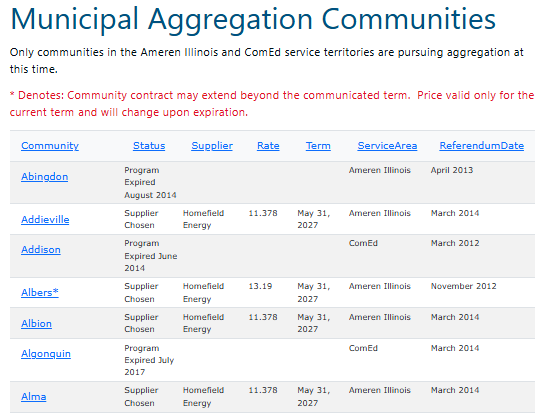
CUB’s analysis comparing all 434 active offers against current utility prices:
| Utility Territory | Aggregation offers charging MORE than the utility price | Aggregation offers charging LESS than the utility price | Aggregation offers that are nearly equal (±0.005¢/kWh) to the utility price | Aggregation offers that contractually match the utility price |
| Ameren | 245 (94.6%) | 14 (5.4%) | 0 | 0 |
| ComEd | 6 (3.4%) | 89 (50.9%) | 10 (5.7%) | 70 (40.0%) |
In Ameren territory, the overwhelming majority of municipal aggregation deals — 94.6 percent — were more expensive than the utility’s supply price — by 0.7 cents per kWh on average, and up to 2.2 cents per kWh in the worst cases, according to CUB’s review. And remember, Ameren’s supply rate is seasonal and is expected to go down on Oct. 1, making municipal aggregation offers that are currently losing money even worse deals.
The lowest rate offered in Ameren territory was 9.999 cents per kWh, in Canton, while the highest rate was 13.529 cents per kWh, in Vermillion County.
In ComEd territory, half of the active offers were charging less than the utility’s supply price, and another 40 percent were contractually indexed to match ComEd’s price exactly, meaning those communities can’t end up worse off than the utility default rate, even as prices move. Additionally, about 6 percent of plans were extremely close to ComEd’s price–just a fraction of a penny higher or lower.
The lowest rate offered in ComEd territory was 6.79 cents per kWh, in Cortland Township, while the highest rate was 10.90 cents per kWh, in Lake Zurich and Riverside.
In CUB’s review, each territory had a dominant municipal aggregation supplier. Homefield Energy holds 187 of Ameren’s 259 active deals (72 percent), and its contracts average 0.6 cents per kWh higher than Ameren’s supply price.
On the ComEd side, MC Squared Energy Services holds 135 of the 175 active deals (77 percent), averaging 1.4 cents per kWh less than ComEd’s supply rate, with many of its contracts indexed to the utility supply price
In Summary:
- Check your bill’s supply line to see what your current supplier is and what rate you’re paying.
- If you’re in Ameren territory, there’s a good chance your community’s aggregation rate is currently more expensive than the utility’s supply price.
- If you’re in ComEd territory, you’re more likely to be at or below ComEd’s supply price.
- If your aggregation rate is currently more expensive than the utility’s supply price, you can opt out and return to your default utility service without paying an exit fee. To do so, just call the supplier listed on your bill. Reasonably priced municipal aggregation green plans can be a legitimate option for interested consumers. Below, CUB lists other choices that can help you be green and cut your utility bills at the same time.
- If you are looking for ways to potentially cut your electric bill, Illinois has multiple options:
- Energy efficiency programs offered by ComEd and Ameren.
- ComEd Peak Time Savings or Ameren Peak Time Rewards. These programs give you a bill credit if you’re able to reduce your energy usage for a limited number of hours on certain days (typically hot summer afternoons) when electricity demand is highest.
- ComEd’s Hourly Pricing and Ameren’s Power Smart Pricing programs, which charge a market rate that can change hourly.
- ComEd’s Delivery Time-of-Day and Time-of-Day programs, which could save the right households money.
- Community Solar, which offers the benefits of solar (lower bills) without having to install panels on your property.
- Home Battery/Time of Use rate offers. This year a new type of offer has hit the Illinois market, combining a time-variant alternative supply rate with the installation of backup battery storage. These offers, only available in parts of ComEd’s territory, are made possible by the Clean and Reliable Grid Affordability (CRGA) Act. They aren’t for everyone, but could benefit the right household while improving the stability of Illinois’ power grid. Please read CUB’s Q&A.
- If you do want to shop for other alternative suppliers, be careful. CUB’s ongoing analysis has found that Illinois consumers have so far lost more than $2 billion to alternative suppliers since 2015.
Where to find the list of participating communities and their current deals:
- To find the list of municipal aggregation deals, go to: PlugIn.Illinois.gov → Municipal Aggregation → Municipal Aggregation Communities
- Each entry shows the supplier, the contract rate, the term, and the original referendum date.
- Only “Supplier Chosen” entries with a contract end date still in the future represent a live offer.
