
Commonwealth Edison’s Time-of-Day (TOD) Pricing is an optional program that can save you money when you shift your electricity use to cheaper times of day. (Read a PDF version of this Q&A.)
It is similar to ComEd’s Delivery Time-of-Day (Delivery TOD) Pricing) program. However, Delivery TOD only covers the delivery side of the electric bill–what ComEd charges to maintain its wires and deliver electricity to homes. TOD extends the same approach to both the delivery and supply (what you pay for the electricity itself) sides of the bill.
TOD is designed to incentivize participants to shift the bulk of their electricity usage away from times when electricity demand is highest. Such programs can help participants save money, and also make the grid cleaner and more reliable.
How does Time-of-Day Pricing work?
Traditionally, ComEd customers paid for electricity (measured in kilowatt-hours or kWh) at supply and delivery prices that don’t change throughout the day. Under these standard rates, the “Distribution Facility Charge”–a per-kWh delivery charge–only changes after rate cases. And the supply price for electricity only changes a few times a year–most ComEd customers pay a summer (June through September) and a non-summer (October through May) rate.
TOD divides the day into four pricing periods that apply to both supply and delivery, every day, 365 days a year. The most expensive period is the Mid-Day Peak pricing period, 1 p.m. to 7 p.m., because it covers the hours when electricity demand and the market price of power are typically highest.
| Pricing Period | Hours | Price/kWh |
| Morning | 6a–1p | $$ |
| Mid-Day Peak | 1p–7p | $$$ |
| Evening | 7p–9p | $$ |
| Overnight | 9p–6a | $ |
Source: ComEd Time-of-Day Pricing FAQs.
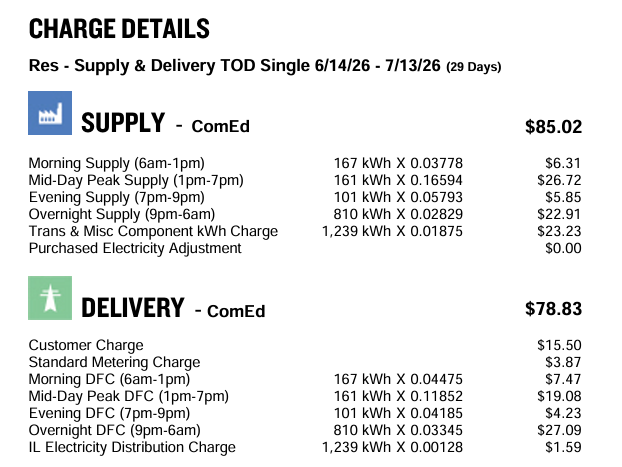
A ComEd bill (single-family home, non-electric heat) with TOD pricing.
What are the benefits of TOD Pricing?
Lower bills: While savings are not guaranteed, participants can save money on the TOD program, compared with standard rates, by limiting their electricity usage during the Mid-Day Peak period. Usage during the rest of the day is cheaper than it would be under standard rates. The more you shift your usage to outside of the 1 p.m. to 7 p.m. window, the more you can save. Doing so then benefits everyone because reducing stress on the system during peak demand hours reduces the capacity and infrastructure costs that all electric customers share.
Improved reliability: Reducing stress on the grid during peak hours also improves reliability because the highest-cost hours are the highest-demand hours, when the grid is stretched to its limits and power-outage threats are greatest.
Cleaner Grid: Most “peaker” power plants–the plants that only get used during peak-demand periods–run on fossil fuels. Programs like TOD are good for the environment, because they lower electricity demand during peak hours and thereby lessen the need to run polluting power plants.
What are the current TOD charges?
Below is a summary of the current TOD rates as of 2026. TOD supply rates–both a summer price and a non-summer price–are the same for all eligible customers. TOD delivery rates will vary by delivery class for residential customers (single-family or multi-family, electric heat or non-electric heat). You can see your rate class listed at the top of your bill.
The Mid-Day Peak price is higher than standard ComEd rates, but all other pricing periods feature rates that are lower than ComEd’s standard rate.
Single-Family (Non-Electric Heat)
Standard Delivery Distribution Charge: 6.228¢ per kWh
Standard Supply Charge (Summer): 10.399¢ per kWh
Under Time-of-Day:
| Pricing Period | Hours | Summer Supply
Price/kWh (June-Sept.) |
Non-Summer Supply
Price/kWh (Oct.-May) |
Delivery Price/kWh |
| Morning | 6a–1p | 3.778¢ | 4.768¢ | 4.475¢ |
| Mid-Day Peak | 1p–7p | 16.594¢ | 14.699¢ | 11.852¢ |
| Evening | 7p–9p | 5.793¢ | 6.009¢ | 4.185¢ |
| Overnight | 9p–6a | 2.829¢ | 3.394¢ | 3.345¢ |
Multi-Family (Non-Electric Heat)
Standard Delivery Distribution Charge: 4.791¢ per kWh
Standard Supply Charge (Summer): 10.399¢ per kWh
Under Time-of-Day:
| Pricing Period | Hours | Summer Supply
Price/kWh (June-Sept.) |
Non-Summer Supply
Price/kWh (Oct.-May) |
Delivery Price/kWh |
| Morning | 6a–1p | 3.778¢ | 4.768¢ | 3.456¢ |
| Mid-Day Peak | 1p–7p | 16.594¢ | 14.699¢ | 9.660¢ |
| Evening | 7p–9p | 5.793¢ | 6.009¢ | 3.216¢ |
| Overnight | 9p–6a | 2.829¢ | 3.394¢ | 2.400¢ |
Single-Family (Electric Heat)
Standard Distribution Charge: 3.165¢ per kWh
Standard Supply Charge (Summer): 10.399¢ per kWh
Under Time-of-Day:
| Pricing Period | Hours | Summer Supply
Price/kWh (June-Sept.) |
Non-Summer Supply
Price/kWh (Oct.-May) |
Delivery Price/kWh |
| Morning | 6a–1p | 3.778¢ | 4.768¢ | 2.387¢ |
| Mid-Day Peak | 1p–7p | 16.594¢ | 14.699¢ | 6.258¢ |
| Evening | 7p–9p | 5.793¢ | 6.009¢ | 2.260¢ |
| Overnight | 9p–6a | 2.829¢ | 3.394¢ | 1.865¢ |
Multi-Family (Electric Heat)
Standard Distribution Charge: 2.996¢ per kWh
Standard Supply Charge (Summer): 10.399¢ per kWh
Under Time-of-Day:
| Pricing Period | Hours | Summer Supply
Price/kWh (June-Sept.) |
Non-Summer Supply
Price/kWh (Oct.-May) |
Delivery Price/kWh |
| Morning | 6a–1p | 3.778¢ | 4.768¢ | 2.290¢ |
| Mid-Day Peak | 1p–7p | 16.594¢ | 14.699¢ | 5.820¢ |
| Evening | 7p–9p | 5.793¢ | 6.009¢ | 2.172¢ |
| Overnight | 9p–6a | 2.829¢ | 3.394¢ | 1.812¢ |
Source: ComEd tariffs. Note: Actual bills vary by delivery class and season. Login to comed.com and use ComEd’s Rate Comparison Tool in My Account for a personalized comparison.
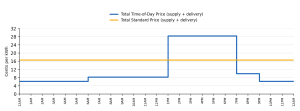
With TOD pricing, participants can save money by avoiding the Mid-Day Peak period. Note: This graphic compares per-kWh supply and delivery prices for Standard and TOD single-family homes without electric heating, as of August 2026.
What customers are good candidates for TOD Pricing?
You save money by avoiding heavy electricity usage during the highest-priced period: the Mid-Day Peak. The best candidates are households that…
- Can set the thermostat a few degrees warmer between 1 p.m. and 7 p.m. in summer.
- Can shift dishwasher, dryer, and washing-machine use outside the peak window. (Use cold water to wash dishes and clothes. Use light sensors and timing to save on lighting, and change out HVAC filters regularly.)
- Are electric-heat customers who can set the thermostat cooler between 1 p.m. and 7 p.m. in colder months. (Note: Customers whose primary building heating system is all-electric are eligible for a lower rate. The same discount applies to both default ComEd rate customers and TOD customers, but you have to inform ComEd that you’re all-electric for them to give you the discount. More information is available here.)
- Drive an EV and can charge overnight, when rates are lowest. (Extra benefit: Registering an EV at the time of TOD enrollment earns a $2 per month credit per vehicle, up to two vehicles, for 24 months.)
Are any customers NOT good candidates?
- Households that are unable to adjust their heaviest electricity usage to avoid the high-priced Mid-Peak period are NOT good candidates for TOD pricing, but they should consider other options from ComEd, including energy efficiency programs and Peak Time Savings.
- Customers on an alternative electric supplier must terminate that service before enrolling in TOD pricing. Unlike with Delivery Time of Day Pricing, combined TOD Pricing cannot be paired with any other supply offering, including an alternative supplier plan or ComEd’s Hourly Pricing rate.
- Important note for solar customers: Legacy net metering customers (those whose solar systems were interconnected before Jan. 1, 2025, and have no Distributed Generation rebate) are not eligible for TOD Pricing. Other net metering customers who installed their solar panels after Jan. 1, 2025 and received a DG/storage rebate could save money on TOD. Check with ComEd to determine if you’re a good candidate.
Is TOD the same as Hourly Pricing?
TOD and Hourly Pricing are both time-variant rates, but they are different. While TOD pricing charges per-kWh supply and delivery rates according to four pricing periods that are the same every day, Hourly Pricing covers the supply side of the bill only, and it charges a per-kWh rate that changes hourly, according to real-time wholesale market prices. In addition to not knowing the prices ahead of time, Hourly Pricing differs in that it has a fixed monthly Capacity Charge based on the customer’s usage during the highest system peak demand hours during the previous year. The supply portion of TOD pricing is based on the historical average of real-time wholesale market prices, so the pattern of trending higher in the afternoon and lowest overnight is the same. Read more about Hourly Pricing.
Note to Hourly Pricing customers: TOD cannot be paired with Hourly Pricing–because they are both supply rates. However, Delivery TOD and Hourly Pricing are compatible with each other and offer the potential to save.
How do I learn more?
Visit ComEd’s Time-of-Day Pricing page, which includes Frequently Asked Questions.
ComEd offers a Rate Comparison Tool that examines your historical usage data and estimates how much you could expect to pay over the next 12 months under your current rate versus ComEd’s Time-of-Day Pricing program. (Remember, the more you can avoid using electricity during the high-priced Mid-Day Peak period, the more you can save with TOD.)
Also, ComEd has a chart that summarizes and compares its various pricing offers, including TOD. It could be a useful tool in helping you to decide whether TOD is right for you.
How do I enroll?
Enroll through ComEd’s Time-of-Day Pricing page.
It can take up to three billing cycles to finalize your enrollment in TOD pricing.
You can leave TOD Pricing at any time without penalty–but it can take up to three billing cycles for the cancellation to be processed. Note that if you are receiving the $2 per month credit for owning an electric vehicle, under TOD, you will forfeit any remaining EV credits if you move to a flat rate for both supply and delivery. EV owners who are on a time-variant supply rate (TOD, Hourly, or a time-variant rate from an alternative supplier) and/or the Delivery TOD rate are eligible for the monthly bill credit.
