
PJM’s new plan would require data centers to bring their own energy or face power reductions—but relies on states to shield consumers from rising bills.
After an uphill battle, CUB is relieved to deliver some promising news: It appears PJM Interconnection, the nation’s largest power grid operator, is finally taking meaningful action to hold data centers accountable for their costs. But it requires a lot of help from the states.
For more than a year now, millions of everyday electricity customers across the PJM region have been forced to pay higher and higher bills to subsidize Big Tech—data centers cost consumers an alarming $29.4 billion in recent capacity auctions alone.
A chorus of critics, from consumer advocates to governors to federal regulators, has been applying pressure on PJM to address skyrocketing electricity costs driven by data centers. And earlier this month, PJM responded with a plan that to many of those critics seemed surprisingly constructive. The Interim Resource Adequacy Service (IRAS) proposal, filed with and awaiting approval from the Federal Energy Regulatory Commission (FERC), sets out that data centers that fail to bring their own capacity will face involuntary power reductions.
Under PJM’s IRAS framework, new large load customers (50 megawatts or more) can enter into bilateral agreements to secure their own capacity supply, or reserve power for emergency grid conditions. Beginning in June 2027, though, large load customers that fail to bring their own capacity to the grid would be subject to curtailment during periods of grid stress, such as heatwaves or cold snaps. Importantly, data center power reductions would come ahead of other pre-emergency measures.
In a big win for consumers, data centers that don’t bring their own power would also be removed from the demand curve in the capacity market—a provision CUB repeatedly fought for PJM to even consider. The PJM Board initially argued for keeping all large load customers–including those subject to curtailment–in the capacity market. Yet if a large load will be curtailed during a capacity event, there is no need to procure capacity to serve it and therefore no need for it to remain on the demand side of the equation driving up costs for everyone else. PJM’s reversal on this means we’re one step closer to ensuring everyday people don’t bear Big Tech’s burden.
As a first step in the IRAS process, PJM would establish a large load registry that would provide state regulators and utilities with information to determine cost allocation for the capacity demands of new data centers and target them for power reductions. But the large load registry won’t be effective without state action–something PJM notes throughout its filing.
PJM’s proposal would allow data centers to be compensated for mandatory power reductions, leaving it to states to decide how those costs would be allocated to customers. But PJM not-so-subtly points out that data centers have the option and, under the Ratepayer Protection Pledge, the obligation, to waive that compensation.
The policy was the outcome of an accelerated stakeholder process, or Critical Issues Fast Path (CIFP), designed to address urgent concerns about grid reliability triggered by the rapid growth of data centers across the region. This was the second in a series of CIFPs on the issues caused by data centers–the first took place in the fall of 2025, and the second commenced in the spring of this year.
As one of the few consumer advocates in the PJM stakeholder process, CUB has been raising the alarm about the downstream impacts of data center capacity demand on both grid stability and rising electricity bills. CUB’s team sees PJM’s proposal as a welcome change, one that could deliver economic relief to millions of consumers across the PJM region. But whether that relief materializes depends on states.
PJM has signaled that it has done what it can within its jurisdiction, and has passed the baton to states across the region. And there are many urgent interventions that can and should be made to protect residents.
Just last week, CUB’s Consumers for a Better Grid campaign published a legislative toolkit for state leaders and policymakers that identifies solutions to address and prevent consumers from bearing data center costs.
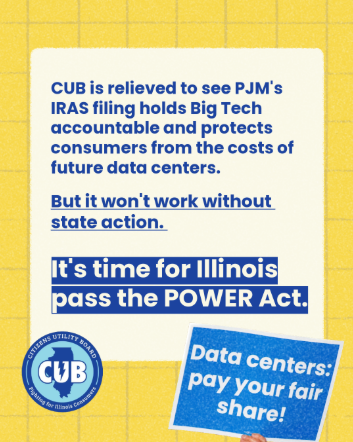
In Illinois, that legislation is already waiting to be passed, and PJM’s filings make adopting the POWER Act all the more urgent. Our leaders must step up to address the energy affordability crisis and ensure that Big Tech foots the bill for their costs—the ball is now in their court.
This article was written as part of our Consumers for a Better Grid Campaign, dedicated to advocating for consumer interests at the largest power grid in the nation. Learn more and sign up for updates here.
