
By Clara Summers
Director, CUB’s Consumers for a Better Grid Campaign
Governance reform at PJM Interconnection was always going to be hard.
PJM is a contradiction in so many ways: it sets rules for the electricity market like a government, but is a private corporation. Its decision-making is controlled by Member companies–mostly big utilities and power generators with a profit motive–but it has an independent board. It was formed to make the electricity system efficient across multiple states, but states have no ability to enforce changes.
PJM’s governance structure was not designed for the challenges it faces today. (It’s questionable whether PJM’s governance structure ever made sense to anyone who cares about consumers–but it’s certainly not designed for the challenges it faces today. )
So when Federal Energy Regulatory Commission Chair Swett announced at the PJM Annual Meeting in May that the Commission planned to hold a Technical Conference on governance, everyone sat up a little straighter in their seats. Participants in the July Technical Conference discussed several possible solutions, ranging from speeding up the stakeholder process to creating a more meaningful role for the states. Much of the discussion centered around PJM’s role (or lack thereof) in serving the public interest. The Commissioners ended with an ultimatum: Reform your governance process by the end of September, or we will do it for you.
But what would a governance reform proposal even look like coming from within PJM, when the PJM Member companies who benefit from the status quo would have to approve any changes?
We now know the answer to this question. Starting at the end of August, select PJM stakeholders, including Members and the states, embarked on a mediation process led by FERC staff. The discussions culminated in 3 proposals–PJM’s, the so-called Members’ (which was not supported by the vast majority of consumer advocates), and the consumer advocates’–all of which went to a full membership vote on September 30.
While there were some steps forward on select topics, the overall package that passed is bad news for consumers.
The good
A few consumer advocate priorities were included in the approved package:
Sector-weighted voting: The lower-level committees are where the details of proposals get worked out, but it’s also where companies can vote multiple times through their affiliates. By applying sector-weighted voting, these companies would no longer be able to dominate the overall vote. For example, the votes will now be weighted so a generation owner with 21 affiliate companies can’t overpower a single consumer advocate.
Voting transparency: While we were not able to get full voting transparency, the votes of affiliate companies will now be reported in the lower-level committees. This is necessary, since utilities in states where they are newly required to report their votes are already breaking the law.
Cost-benefit analysis: Shockingly–even though PJM decisions can end up costing everyday electricity customers billions of dollars–it is rare for there to be any cost-benefit analysis of proposals in the PJM stakeholder process. PJM will now be required to provide cost-benefit analyses of proposals when they are first presented at the upper-level committee. There is some troublesome language buried in the proposal that may make this optional, but we will continue to fight for cost oversight.
The bad
Despite lip service to the public interest at FERC’s Technical Conference, PJM Members ultimately approved weak language in their “reform package.” Similarly, while we will now have better insight into how the PJM Board makes decisions, we were denied the healthy transparency needed for a process that has such a profound effect on how clean, reliable, and affordable our electricity is. Other key priorities, like an Independent Transmission Monitor to oversee transmission costs, and a new sector just for consumer advocates, never advanced beyond our consumer advocate proposal.
The ugly
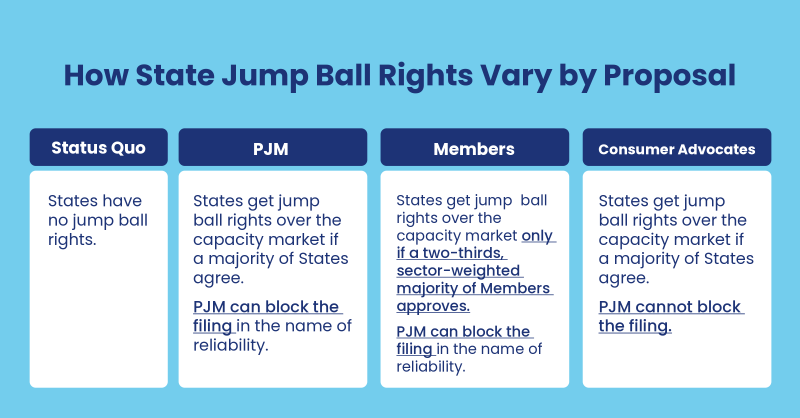
Most contentious was the role of states at PJM—specifically whether the Organization of the PJM States (OPSI) should gain formal power through a “jump ball.” In this context, a jump ball is the ability to have an alternate proposal considered by FERC, to be evaluated under the same standard of proof as PJM’s own filings. Like a jump ball in basketball, this allows the filing parties to start with even footing, rather than one party having an inherent advantage.
Most proposals require Member endorsement to enjoy the lowest burden of proof at FERC. The exception is proposals concerning the capacity market, for which PJM staff do not need Member approval. In their base proposal, PJM expanded the rights of its staff to file proposals on all topics at FERC under this same, lower standard, without Member approval. The states wanted the right to submit proposals for changes to the capacity market at this same standard.
The PJM proposal would have granted states a jump ball over the capacity market, provided a majority of states agreed on the filing. Our consumer advocate proposal also gave the states this right. In stark contrast, the Members’ proposal conditioned jump ball filing rights for states upon approval by a two-thirds, sector-weighted majority of Members–which amounts to a veto on the will of the states. Given that PJM’s membership is dominated by companies that profit off higher capacity prices, this presents a major barrier to the states acting in the public interest.
In short: the proposal that passed would allow elected and appointed state leaders to make changes only if private companies beholden to shareholders approve of them. In no way does that safeguard the public interest or affordability.
The fallout
On September 30, PJM’s Members (minus the vast majority of consumer advocates) voted overwhelmingly to wield veto power over the States. As of this writing, PJM staff are turning the Members proposal into a form that can be filed at FERC, though it is unclear whether the PJM Board is required to file the proposal as-is, or if they can make modifications.
Back in July, Chair Swett said that “PJM is facing a grave legitimacy crisis.” It remains to be seen whether FERC will be satisfied with the reforms proposed by Member companies. Even if FERC is dissatisfied, it is unclear how the Commission will respond. Historically, the Commission has interpreted its oversight of governance very narrowly. FERC is responsible for evaluating and enforcing “just and reasonable rates,” and it can be difficult to tie governance structures directly to rates.
However, it is clear to us that rules written by companies that profit from those very rules directly lead to unjust and unreasonable rates. PJM’s governance structure is indefensible. It’s past time for reform, and we hope FERC recognizes that the Members’ narrow, self-serving proposal does not meet the challenge.
This article was written as part of CUB’s Consumers for a Better Grid Campaign, dedicated to advocating for consumer interests at the largest power grid in the nation. Learn more and sign up for updates here.
