
As the public backlash against data centers escalates across Illinois, newly disclosed records reveal that fees the controversial facilities paid to Commonwealth Edison over the last five years fell billions of dollars short of the total price tag expected to connect them to the electric grid. Public-interest groups warned Thursday that consumers could face higher power bills to make up the difference, and they stressed that regulatory and legislative reforms are needed to adequately protect customers from paying even more in the future. (Read a pdf of the news release.)
Records obtained from ComEd indicate that the utility expects to spend $3 billion to connect data centers to its transmission and distribution system over the next few years. Yet the data centers have only paid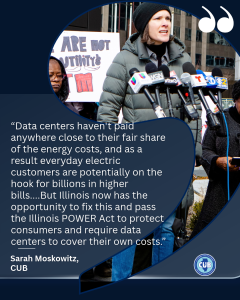 about $720.9 million in deposits, according to ComEd’s records, meaning the utility could spend several times the amount it says it has collected from the proposed facilities themselves without any guarantee of recouping that payment. ComEd’s more than 4 million customers are already paying higher bills to cover at least part of that total, effectively forcing them to subsidize data centers––and they could be on the hook for even greater financial harm to close that gap.
The findings corroborate concerns that data centers, despite their ties to some of the world’s wealthiest Big Tech corporations, are poised to unfairly foist a significant portion of their energy-related costs on everyday electricity customers. Spiking electricity bills have sparked an affordability crisis, prompting a nationwide backlash against data center development. Illinois lawmakers are considering passing the POWER Act, which has comprehensive consumer protections that would require data centers to cover 100 percent of the energy and infrastructure costs they cause.
“Data centers haven’t paid anywhere close to their fair share of the energy costs, and as a result everyday electric customers are potentially on the hook for billions in higher bills,” Citizens Utility Board (CUB) Executive Director Sarah Moskowitz said. “Illinois consumers potentially are bearing the burden for some of the wealthiest corporations in the world–it’s not right. But Illinois now has the opportunity to fix this and pass the Illinois POWER Act to protect consumers and require data centers to cover their own costs.”
The General Assembly did not take up the POWER Act in the 2026 Spring legislative session–even though Illinois residents increasingly view the facilities as unwelcome interlopers that threaten the environment, clean water and their electric bills. The state ranks fourth (behind Virginia, Texas, and California) with 262 operating or planned data centers, the Pew Research Center reported in April. In that same month, a statewide poll of likely 2026 voters revealed deep skepticism about data centers, and strong, bipartisan support (about 70 percent on up) for the POWER Act. The provisions requiring data centers to pay their own costs received more than 90 percent support.
ComEd’s electricity supply price is about 50 percent higher than just two years ago, thanks to surging demand projected for new and proposed data centers. On top of higher supply prices, data centers also threaten customers with higher delivery and transmission charges to cover data center-related upgrades and expansions to ComEd’s electricity system – even if the proposed centers never get built.
ComEd recently increased deposits for large load customers like data centers and introduced a new “transmission service agreement” approach where these customers pay off a portion of their interconnection charges over time. In April, the Illinois Commerce Commission (ICC) approved these policies as part of ComEd’s “large-load tariff” for assigning such costs to data centers and other big electricity users. However, in the same order approving the new rules, the ICC found them inadequate to fully protect existing electric customers from shouldering data center costs.
The ICC initiated another proceeding (Docket 26-0364) to explore doing more to protect residential and small business customers. In the latest case, energy consultant James Fine filed expert testimony on behalf of several advocates showing residential ratepayers could subsidize energy infrastructure for large data centers.
Fine analyzed a ComEd list of 30 large-load projects already interconnected or requesting service from 2021 through 2031. ComEd calculated that those projects would require more than $3 billion in transmission and distribution infrastructure improvements. Yet deposits and advance payment commitments from those projects cover just under 25 percent of that estimate, leaving a potential shortfall of more than $2 billion, according to ComEd’s records. “This leaves a very large gap,” Fine wrote. “Moreover, the $3 billion figure is an estimate—the actual number could be much larger as a result of cost overruns or facilities that ComEd did not include in its total.” Advocates said the list does not include 60 additional large-load projects that have been more recently proposed.
Fine recommended that large customers like data centers pay for 100 percent of their grid-connection infrastructure up front, which would ensure that other customers don’t foot the bill. The expert testimony was jointly filed by CUB, Environmental Law & Policy Center (ELPC), Natural Resources Defense Council (NRDC), Vote Solar, and the Union of Concerned Scientists.
“Ordinary households should not foot the bill to provide power to data centers,” said Nick Wallace, Senior Associate Attorney at the Environmental Law & Policy Center.. “ComEd and the Commission can protect ratepayers and the grid by requiring data centers to pay for 100 percent of their power supply and infrastructure investments.”
“It’s imperative that the ICC require new data centers to pay the fair share of all their energy demands – from their own new clean energy down to the poles and wires needed to hook up to ComEd’s grid.” said Kari Ross, Midwest Energy Affordability Advocate at NRDC. “In passing the POWER Act this fall, Illinois can lead the country by codifying this policy across the state and enshrining everyday electric customers from shouldering the pricey energy needs of Big Tech.”
“As data centers and other large energy users drive unprecedented demand and costly investments in our electric grid, our aim throughout this debate across the region has been to ensure that commissions use the tools they already have to allocate these costs appropriately and to prevent the costs of serving data centers from being shifted onto residential customers,” said Will Kenworthy, Vote Solar’s Senior Regulatory Director. “The Illinois POWER Act will reinforce that principle, strengthening accountability for large energy users and protecting families from higher bills.”
“Prior analysis by the Union of Concerned Scientists found that data center-driven load increases could put Illinoisans at financial risk for up to $37 billion in additional electricity system costs,” said James Gignac, Midwest Policy Director with the Union of Concerned Scientists. “While ComEd and the Illinois Commerce Commission are taking steps to shield customers from these costs, state legislators need to pass the POWER Act and ensure data centers pay upfront for their grid connection costs and don’t disappear later leaving everyone else with their bill.”
To prevent data center-related costs from being shifted to the rest of residential customers, Fine recommended that ComEd design a large-load tariff that is “fully protective of existing customers,” using various mechanisms–such as minimum monthly fees and exit fees to make data centers pay their fair share. Other expert testimony filed by CUB and its partners pushed for ComEd’s large-load tariff to include interruptible service requirements. That means the utility could reduce service to data centers when demand is highest–unless those facilities pay for their own new, clean energy to cover their electricity needs during such times. This is necessary to stop large data centers from increasing energy supply costs for all customers and causing preventable blackouts.
Consumer advocates have worked to protect consumers in multiple cases before the ICC, but they say the problem calls for a more comprehensive and statewide solution that can only be provided by the Illinois General Assembly.
The POWER Act would implement many of the reforms recommended in consumers advocates’ testimony, but go even further. It would create a requirement for utilities to make data centers their own rate class, protecting residential customers from covering any data center-related costs on the delivery side of bills. The Act also would protect consumers from spikes on the supply side of the bill by requiring data centers to bring their own new capacity (or reduce their usage during high-demand hours) and bring their own new clean energy (or pay the real cost for the State to do it).
Consumer advocates are continuing to push the legislation out of concern that bills will get even higher without decisive state action. Gov. Pritzker’s Administration gave these efforts a boost after the 2026 Spring session by pausing new tax incentives for data centers in Illinois and outlining a framework on how to protect Illinois consumers from data center-related energy costs, which closely tracks the POWER Act.
