
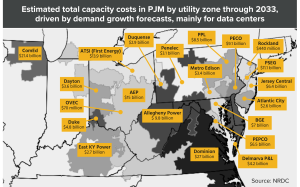
An analysis by the Natural Resources Defense Council found that data center growth could result in a total of $163 billion in cumulative capacity costs from 2028 through 2033. That translates to a $70-per-month increase for the average household in the PJM region. Click the image to read a fact sheet.
After months of suspense, the PJM Interconnection Board has proposed a series of policy changes on how to manage data center energy demand–a challenge that, if left unchecked, could in a few years spark catastrophic blackouts and price spikes for the 67 million customers who live in the nation’s largest power grid region.
PJM’s announcement on Friday, Jan. 16 was the culmination of an accelerated decision-making process called the Critical Issues Fast Path (aka CIFP) – Large Load Additions in which stakeholders–utilities, power generators, and consumer advocates like CUB–weighed in on how best to tackle soaring data center energy demand that has led to record-high prices in three straight capacity auctions, (In the last auction, 40 percent of the cost was driven by data center demand.)
PJM’s announcement wasn’t the only drama involving our electric bills that day: Just hours before the PJM Board released their decision, all 13 PJM state governors (but not the District of Columbia) and the White House released a set of principles that broadly aligns with what the PJM Board ultimately announced.
Let’s walk through the PJM Board’s decision and what it means for consumers. As with most things energy, the devil is very much in the details.
The Summary:
We have the details below for those who want to dig deep, but the “TL;DR” version is: The proposal is good for reliability because under it, data centers would get turned off first during a grid emergency–although this will require state action to ensure that it’s data centers, and not other customers in the zone, who lose power.
The proposal includes some key affordability provisions, like requiring data centers to bring their own new generation for normal grid service. But some big questions have yet to be answered—such as whether and how data centers will be separated into a different capacity market that insulates the rest of us from their costs.
PJM stakeholders will be embarking on yet more stakeholder negotiations to determine next steps.
The Details:
Here are several important issues that came out of both the PJM and Governors/White House announcements–the boxes at the right show the relevant language from each announcement.
Load forecasting
| PJM Board Language |
Governors/White House (G/WH) Language |
| Significant load forecasting improvements | Improve load forecasting |
CUB is encouraged to see improvements to PJM’s “load forecasting”–that’s a reform consumer advocates have wanted for years. Load forecasts are the long-term estimates of electricity demand in the future. We all pay for capacity to meet that demand, so it’s important to get it right. But under the current paradigm, we pay for speculative or duplicative data centers—unnecessarily raising our costs. Changes to the load forecast process to counter data center “hype” are welcome.
Bring Your Own New Generation
| PJM Board Language | G/WH Language |
| Voluntary Bring Your Own New Generation (BYONG), paired with expedited interconnection track | Allocate costs to data centers/accelerate ongoing generator interconnection studies |
Requiring energy-guzzling data centers to bring their own new generation is fundamental to getting us out of an affordability and reliability mess. We are heartened that the PJM Board heard this message and are requiring data centers to bring their own new generation, or accept that their service could be interrupted during high demand emergency periods.
A word of caution: PJM also offers data centers a fast-track connection process for their own generation. Giving data centers this special treatment will hurt consumers. Not only will it create an incentive for power generators with new plants to only contract with lucrative data centers, reducing the amount available for the rest of us, but it will also cut in front of all the generation that has been waiting in line—for 5 years or more—to connect and start producing. (For years, CUB has proclaimed from the rooftops that PJM’s foot-dragging on interconnections has been a major barrier to securing affordable, reliable energy for everyday consumers–and it’s even more critical during the data center surge.) Also, the proposed design for the fast-track would effectively limit participation to fossil-fueled power plants. Rather than giving data centers a special fossil fuel fast-track, PJM should reform the interconnection queue for everyone, so we can all get cleaner, affordable power faster.
| PJM Board Language | G/WH Language |
| Connect and manage for new large load additions that do not BYONG and curtailment prior to emergency demand response in circumstances necessitating load shed | N/A |
Connect and Manage
That’s a lot of PJM jargon. It means that any data center that doesn’t choose the voluntary “Bring Your Own New Generation (BYONG)” option can still connect, but its utility zone will be shut off first during grid emergencies (this is called “curtailment”). In order to make sure that data centers are curtailed before residential consumers or important infrastructure, such as hospitals, states will need to update their rules to ensure that data centers are first in line to be turned off.
Reliability Backstop
| PJM Board Language | G/WH Language |
| Immediate initiation of reliability backstop procurement |
Provide revenue certainty to new generation |
So what is the “Reliability Backstop”? This would lock in a fixed capacity price for up to 15 years (for the nerds: this means that PJM moves from managing a competitive market to becoming a “cost-of-service” regulator).
CUB’s understanding is that the Board’s intent, going forward, is for all data centers, whether they BYONG or not, to be in a separate Reliability Backstop market. However, the language in PJM’s proposal is ambiguous and says that data centers should be reflected in the capacity market—the Board needs to clarify this further. Generally, opening up the Reliability Backstop raises risks and will require careful design to make sure the costs only fall on data centers.
If designed correctly, separating out data centers into another market would be a good thing, because it will insulate the rest of us from their capacity costs. However, there are several risks. With two markets, there will be an incentive for power generators to remove themselves from the existing “organic” load market and contract with high-paying data centers in the second market. The result will be less generation for existing customers, which will drive up prices for everyday consumers.
It’s also really important that any data center-only market be limited to genuinely NEW generation–and the definition is important. “New” generation must be exclusively defined as units that have not previously participated in the capacity market. To be clear, units undergoing fuel switching or attesting that they would otherwise retire do not count as “NEW.” This came up during the CIFP process, so it’s something we’re watching.
Capacity market drama
| PJM Board Language | G/WH Language |
| Holistic review of investment incentives in PJM’s markets in 2026 |
Return PJM to market fundamentals |
No one knows for sure what a “holistic review of investment incentives” means, but any process that is focused on incentives for generators and not affordability for consumers is likely about raising our costs. Similarly, the White House’s “market fundamentals” statement also gives us pause, because it could echo previous statements that have been made about turning the capacity market into a market that only props up the dirtiest and most expensive resources (fossil fuels).
Price collar
| PJM Board Language | G/WH Language |
| Feedback request on price collar for 2028/2029 and 2029/2030 capacity auctions |
Protect residential customers from capacity price increases |
Until data center load is dealt with and the interconnection queue is functional, the lower price cap negotiated last year by Pennsylvania Gov. Josh Shapiro must be extended. These out-of-market forces that are artificially pushing up prices must be addressed before we go back to business as usual–no ifs, ands, or buts about it. But here’s one important difference: The price cap should be extended, but not the price floor. Having a floor merely serves to inflate costs for consumers when prices could otherwise be low.
While PJM has taken steps with this announcement, there is still a lot that states need to do to hold data centers accountable for their costs. States can go further than PJM and require data centers to BYONG and also operate at standards of maximum energy efficiency and load flexibility (They should be required to power down in energy emergencies.)
States also have some powers that PJM doesn’t: They must ensure that data centers pay their own costs through special rate classes for large loads, and that data centers are turned off first during a grid crisis.
And Congress has a role, which is why CUB recently publicly supported new legislation to hold data centers accountable.
At CUB, we will continue to advocate for solutions at all levels.
This article is part of CUB’s Consumers for a Better Grid campaign. Sign up here to get alerts for campaign news.
