
CUB regularly receives questions about community solar billing, so we put together this Q&A.
What is Community Solar?
Community solar is a program for people who can’t put solar on their own homes. It allows consumers to save money on their electric bills from energy produced by large, offsite community solar projects, similar to how you would save on your electric bill if you installed panels on your own property. The owner of the community solar installation–called a “farm” or a “garden”– pays the upfront costs to build, maintain and connect the garden to the utility’s power grid. When you sign up for community solar, you are subscribing to a portion of the project’s monthly output. Your community solar provider will analyze your household’s energy demand to determine your subscription size.
How does Community Solar billing work?
Each month, you’ll pay your community solar provider for the amount of electricity generated by your subscription. The provider then reports the output of your subscription to the utility, and the utility company adds credits to your electric bill equal to that output. You can think of this as paying your community solar company for the electricity generated by your panels, rather than paying your utility for that electricity. There are two ways this can happen, through dual billing, and through consolidated billing. We will go through each option below.
Dual Billing
Dual billing involves two bills–one from your utility, and one from your community solar provider.
The Utility bill
Your utility bill will look mostly the same, but with some additional line items and sections that provide information about your community solar subscription.
ComEd: The ComEd bill will have a “Renewable Community Supply Details” section, which will provide the name of the community solar farm and the phone number, the generation period and amount, and the credit amount. The credit amount is the monetary value of the electricity that your subscription produced this month. The credit will also show up under the supply portion of the bill. That credit amount will be subtracted from your ComEd bill. Rather than paying ComEd for that electricity, you will pay the community solar provider directly. Any roll-over credits will be tracked under the miscellaneous section of the bill.
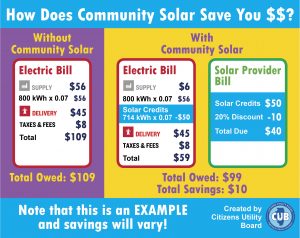
Dual billing.
Ameren: The amount of generation from your community solar subscription will be located at the top of the bill (under Usage Summary), via the line item called “Off-Site Gen kWh”. The Ameren bill will provide more information about your community solar farm at the bottom of the bill, under the Renewable Generation section. There, you can view the monetary value of that credit. (Read Ameren’s Community Solar Bill Explainer.)
The Community Solar Bill
Rather than paying your utility for the electricity generated by your subscription, you will pay your community solar company for that power. Your community solar company will send you a SEPARATE bill. You will pay them directly, either through a monthly bill or through an automatic payment setup. This means you will have two bills, one from your community solar provider and one from your utility company. Because most community solar farms receive both state and federal incentives, these companies are able to pass on savings to customers. Most companies offer a discount of 10-20 percent off the utility rate (or higher for income-eligible farms). So the amount you actually pay for your subscription-generated electricity will typically be less than what your utility would have charged you. For example, if you are subscribed to a farm that offers a 20 percent discount, and the credit on your utility bill is $50 that month, you will only be charged $40 by your community solar company, leaving you with $10 in savings. To the right is an example of this dual billing format.
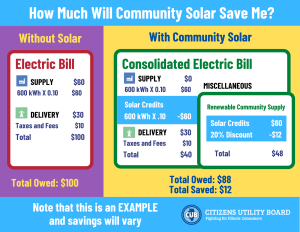
Consolidated billing.
Consolidated Billing
The other billing option for community solar is consolidated billing. With consolidated billing, both the community solar credit and subscription fee will be on the utility bill. The subscription fee is what you owe your community solar provider. You are still paying your community solar provider for the electricity produced by your subscription (rather than paying your utility for that electricity) but the charge will be on your utility bill (as the subscription fee), rather than on a second bill from your community solar company. Your utility will pass this payment on to your community solar provider. To the right is an example of the consolidated billing format.
Budget Billing
Consumers on budget billing and consolidated community solar billing may experience some changes to their bills. Budget billing is a program that levels out seasonal changes in your energy bill by dividing the previous year’s usage into predictable baseline monthly payments. The two programs don’t always seem to be ideally compatible, and CUB has received complaints from Ameren Illinois customers enrolled in both budget billing and community solar. Here’s a summary:
Ameren:
- The issue with adding community solar (consolidated billing) to budget billing is that savings are NOT realized until the monthly bill amounts are recalculated. Meanwhile, customers are having to pay the monthly community solar subscription fee. While savings are eventually realized, they are not realized immediately–and the delay can be difficult for consumers, especially those who are already paying more than they can afford for their electricity bills.
- Ameren is updating their system to address this problem. Following implementation of this solution, community solar subscription fees will no longer be added on top of the monthly budget billing amount. Instead, the subscription fee will be subtracted from the credit amount, and any excess subscription fee will be added to the budget billing balance. This way, customers will not be burdened by an increased bill while waiting for the budget amounts to rebalance.
Community solar + alternative electric suppliers/municipal aggregation
Customers with alternative retail electric suppliers (ARES), whether signed up individually or through a municipal aggregation plan, can also sign up for community solar. (Municipal aggregation deals involve community leaders negotiating an electricity price with an alternative supplier.)
Before deciding between the two, we suggest consumers compare discount rates. There is a chance that an alternative supplier/municipal aggregation savings rate could be higher than a community solar discount rate. If that is the case, community solar would reduce the benefit from the alternative supplier/municipal aggregation savings.
For example: Say the default utility rate is 10 cents per kilowatt-hour (kWh), your alternative supplier rate is 8 cents per kWh, and your community solar discount rate is 10 percent (which would result in 9 cents per kWh). In this example, the alternative supplier rate is better than the community solar discount, so this consumer should stick with the alternative supplier (if their goal is to maximize bill savings).
Be sure to do the math before subscribing!
