
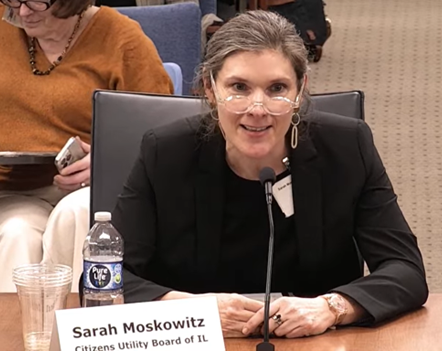
CUB Executive Direct Sarah Moskowitz.
By Sarah Moskowitz, CUB Executive Director
With recent and pending increases in electric and gas bill costs, fed up families, businesses, and policymakers have been reaching out to CUB asking what laws Illinois can pass to slow down this train of runaway rate hikes. Below you’ll find a list of policy proposals that state lawmakers in Springfield can pass to address the energy affordability crisis. This is by no means an exhaustive list. If you have or hear of an idea that is missing from this article, that does not mean CUB opposes it. Please feel free to reach out to CUB with any questions.
Problem: Massive Data Centers Are Driving Up Costs for Everyone.
Solution: Pass the POWER Act (HB 5513 / SB 4016), which would:
- Make data centers pay for all of the grid upgrades built at their request. Data center developers routinely submit very large–often inflated–requests for grid capacity, and under current law they aren’t required to pay for the infrastructure that gets built to meet those requests but ultimately goes unused (“stranded assets”). Illinois should require ComEd and Ameren to create a separate rate class for large data centers, with rates that accurately reflect the higher costs of serving these facilities. The state should require utilities to hold large data centers to mandatory minimum contract terms (“take or pay” contracts) to eliminate the centers’ incentive to overstate their grid needs and ensure they pay for what they ask for, whether they use it or not. (Utilities in Ohio, Indiana, Minnesota, Michigan, and several other states have similar protections in place.)
- Require data centers to Bring Your Own New Clean Energy (“BYONCE”). Data centers’ massive electricity needs are driving up energy supply prices. Illinois should require large data centers to bring their own new generation resources–and/or reduce usage during peak hours–so as to offset the pressure they put on power markets. Meanwhile, Illinois’ Renewable Portfolio Standard (RPS) requires electric utilities to meet rising annual renewable energy targets until the state reaches 100 percent clean power in 2050. If large data centers bring their own generation that’s fossil-fueled, it doesn’t help utilities meet that target–leaving everyone else to cover the difference. Illinois should require data centers to “bring your own new clean energy” (BYONCE).
- During peak demand hours, limit data centers’ access to grid power to what they bring themselves. A huge portion of total supply costs are for capacity – paying power generators to be available for the handful of highest-demand hours of the year. A recent study by Princeton University and energy consultancies found that each gigawatt of data center demand adds $764 million in supply capacity costs. Requiring data centers to bring their own capacity to offset their demand or be flexible during peak demand hours reduces the impact on other ratepayers by 96 percent, the study found. (See footnote.*) To this end, the POWER Act would allow data centers to use only as much grid power during peak demand hours as they bring their own new clean capacity resources to the grid.
*Note: This study’s methodology more straightforwardly describes how costs are determined in “vertically integrated” states where, unlike in Illinois, utilities own power plants. The mechanism to pay for these investments works differently in “restructured” states like Illinois, but the scale of the expense and potential impact of requiring data centers to bring their own capacity or be flexible during peak demand hours is similar across regulatory contexts.
Problem: Utilities Charge Their Customers for Expenses that Don’t Improve Service.
Solution: Pass the Utility Transparency Act (HB 4781 / SB 3497), which would prohibit Illinois gas, electric and water utilities from passing along to customers the costs of trade association membership dues, corporate brand promotion, executive misconduct insurance, and paying outside consultants and law firms to defend rate increases before regulators. This would save ratepayers across Illinois more than $40 million in an average year. Similar laws have already passed in Colorado, Connecticut, Maine, Maryland, and California.
Problem: Too Many “Alternative Supplier” Customers Are Overpaying.
- Solution 1: Pass HB4313, the No More Utility Bill Rip-Offs Customer Protection Act. HB 4313 would:
- Cap the rates alternative gas and electric suppliers can charge residential and small commercial customers at 10 percent more than the standard utility rate;
- Ban automatic renewal of high-priced contracts by requiring signed consent to renew;
- Require alternative suppliers to report how much they’re charging customers to the Illinois Commerce Commission; and
- Ban commissions for retail supplier sales representatives.
- Solution 2: Limit Alternative Suppliers to Commercial, Industrial, and Municipal Aggregation Customers. Residential alternative electric supplier customers paid $2 billion more than the standard utility rate from 2015 through 2025. Savings by a minority of these customers are dwarfed by massive losses for the group as a whole. To negotiate a beneficial deal takes a level of research and expertise that is simply unfair to expect from individual customers. In recognition of this reality, Illinois should limit alternative suppliers to contract only with commercial, industrial, and municipal aggregation customers.
- Solution 3: Ban Door-to-Door Supplier Marketing. Despite legal protections on the books, high-pressure door-to-door sales tactics persist. Investigations can take years to make victims whole. The practice has done more harm than good and should be banned.
- Solution 4: Inform Illinoisans of Their Right to Cancel. The HEAT Act gives Illinoisans the right to cancel their alternative supplier contract with no cancellation fee. Every constituent services office should be aware of this and educate their residents of these rights.
Problem: Utilities’ Profit Margins Are Excessive.
- Solution 1: Remove Arbitrary Constraints on the Illinois Commerce Commission’s Ability to Set a Reasonable Authorized Equity Ratio. Under traditional utility ratemaking, utilities charge customers for the cost of service plus a “rate of return” – a profit margin for the utility’s shareholders. The rate of return is split between cost of debt (paying back the utility’s creditors) and cost of equity (profits for the utility’s shareholders). Equity is significantly more expensive than debt, but current state law makes it difficult for the Illinois Commerce Commission (ICC) to authorize an equity ratio below 50 percent for electric utilities. Utilities similar to ComEd and Ameren in other states, however, have significantly lower equity ratios without any credit problems, illustrating that Illinois can be more aggressive in driving equity ratio downward. Policymakers should consider eliminating this arbitrary constraint, or at least lowering the number.
- Solution 2: Place Downward Pressure on Excessive Profit Margins. The other factor in cost of equity is the profit margin that utilities’ shareholders receive, or “return on equity” (ROE). There is a strong case that the entire utility industry’s Commission-approved ROEs significantly overstate what they actually need to raise capital and maintain their credit ratings. In a competitive market for investment dollars, one state can’t move too drastically ahead of others, or local utilities really would struggle to raise funds. That makes trimming this fat an incremental fight, but Illinois has already begun making progress for electric utilities under CEJA, saving consumers hundreds of millions of dollars a year. There’s room for the legislature to drive further savings, and extend them to gas and water utilities, within the legal and practical limitations that apply. In rate cases, parties present a range of ROE estimates they consider reasonable. Court precedent says this amount need not be any higher than strictly necessary, yet state regulators tend to pick a number toward the middle. Illinois can place further downward pressure on this cost, without running afoul of Supreme Court precedent, by enshrining in law a presumption that the bottom of the determined reasonable range, rather than a midpoint, should determine authorized ROE.
- Solution 3: Pair Any Reforms that Reduce Gas Utilities’ Investment Risk with a Corresponding Cost of Capital Decrease. In 2023 orders, the Illinois Commerce Commission (ICC) approved lower returns on equity for electric utilities because the Climate and Equitable Jobs Act reduced their financial risk, thereby making them a safer investment, and therefore did not have to offer as hefty of returns to attract investors. If Illinois adopts similar risk-reduction measures for gas utilities, it should expressly reference in law that these reforms are intended to reduce utilities’ cost of capital. That could enable the ICC to reduce rates without any service-quality impact.
Problem: Electric Transmission Bottlenecks and Planning Delays Drive Up Wholesale Prices, Reduce Access to Low-Cost Energy, and Shift Avoidable Costs Onto Customers Who Have No Control Over These Decisions.
- Solution 1: Grid-Enhancing Technologies. Utilities can get significantly more capacity out of existing transmission lines, much more quickly and cheaply than building more lines, by leveraging sensors, software, and batteries. Ameren and ComEd, which are owned by the same corporations that own most of the transmission lines in their service territories, have been slow to adopt these “grid-enhancing technologies” (“GETs”) because they make more profits overbuilding the system than from being more efficient. Illinois should condition approval of siting and cost recovery for new or upgraded transmission lines and other grid capacity expansion investments on a demonstration that GETs have been fully considered and implemented where they are a more cost-effective solution. Several other states have passed legislation requiring utilities to formally consider GETs as alternatives to more expensive transmission upgrades.
- Solution 2: Allow Transmission Lines Along Highways. The biggest barrier to building new transmission lines is opposition from affected property owners. Illinois can avoid many such conflicts by joining Wisconsin and Minnesota in allowing the colocation of transmission lines in the existing public right of way along highways. Senate Bill 2808 seeks to do so.
- Solution 3: Pre-Approve Appropriate Transmission Line Routes. Siting delays and conflicts can be reduced significantly by the State proactively identifying corridors where transmission lines would have minimal negative impacts. Project developers would then apply for access to those routes, subject to all the public interest factors that apply, but with the siting approval step having already been resolved.
Problem: Traditional Ratemaking Discourages Consumer-Friendly Investments by Utilities.
Solution: Adjust Performance-Based Ratemaking to Replace Basis Points Incentives with Shared Savings. Illinois law provides performance-based incentives that reward electric utilities for improving certain measurable outcomes for customers and penalize backsliding on the same metrics. A shortcoming of the existing system is these incentives take the form of adjustments to the profit rate that the utility receives on all of its capital expenditures. Thus, the incentive payments are bigger the more the company spends, contributing to the “gold-plating” incentive that drives overspending. Performance-based ratemaking should instead base incentive payments on shared savings. If achieving a metric would save customers $X, the utility would be able to collect a percentage of those dollars saved to make the investment profitable. This way, ratepayers and utilities alike come out ahead, without driving gold-plating. Where savings are likely but prove too difficult to calculate precisely, replacing rate of return incentives with appropriate fixed dollar amounts would be beneficial as well.
Problem: Rooftop Solar Installation Is Too Slow and Expensive.
Solution: Streamline Rooftop Solar Permitting. Often the longest delay in the process of getting solar panels on a roof in Illinois is permitting. Local governments responsible for this work are often understaffed and are dealing with every building permit within their jurisdiction. This bottleneck is a huge reason why building owners often have to wait months for work to start. In Australia, the entire process, from signing a contract to having panels up and running, typically takes a few days, making solar systems far less costly to install there. To begin to close this gap, Illinois should adopt a statewide “instant permitting” standard relying on virtual inspections and a free app to automatically determine whether the roof is eligible for solar.
Problem: Utilities Vote in Secret on Regional Grid Policies that Affect Customers.
Solution: Pass HB 1802. ComEd and Ameren are voting members in determining the policies of their respective regional transmission organizations/independent system operators (PJM and MISO), which then impact rates. HB 1802 would require ComEd and Ameren to disclose their votes to the public. CUB is working with advocates in other states across the same grid regions to enact similar policies.
About the Author
Sarah Moskowitz is Executive Director of the Citizens Utility Board, a nonprofit, nonpartisan watchdog for utility customers. She leads the organization’s efforts to identify equitable and consumer-friendly climate solutions while advocating for consumer protections and lower utility bills in Springfield, at the Illinois Commerce Commission, and in the courts. Having started in the summer of 2000, Sarah has served in a variety of roles during her years at CUB, from counseling individual consumers with utility complaints to building CUB’s outreach program into a national leader that staffs hundreds of free events a year showing people how to reduce their costs. Sarah became executive director in the summer of 2023. She earned her bachelor’s and master’s degrees at the University of Chicago.
