
Commonwealth Edison supply customers will see a jump in their electricity price in May, due to a one-month increase in a line item called the Purchased Electricity Adjustment (PEA). ComEd does not profit off the PEA: It’s a charge or a credit that varies monthly, allowing the utility to balance any discrepancies between the predetermined price per kWh and what they actually ended up paying for power on the open market.
This troubling spike in electricity costs is the result of several factors, largely due to strains on the power grid during Winter Storm Fern back in January. CUB and other parties are still analyzing what happened and determining next steps, but meanwhile, here’s a breakdown:
- Typically, the PEA is a charge or a credit of less than 2 cents per kilowatt-hour (kWh). In May, the PEA will be a charge of more than 8 cents per kWh.
- Also in May, the Carbon-Free Energy Resource Adjustment (CFERA) will be an unprecedented credit of more than 6 cents per kWh for most customers, thanks to the Climate and Equitable Jobs Act (CEJA). Previously, the largest this credit has been is around 4 cents per kWh.
- While the CFERA credit will lessen the impact of the PEA spike, it will not completely offset it. The net effect is that ComEd supply customers will pay about 50 percent more for power in May compared with April.
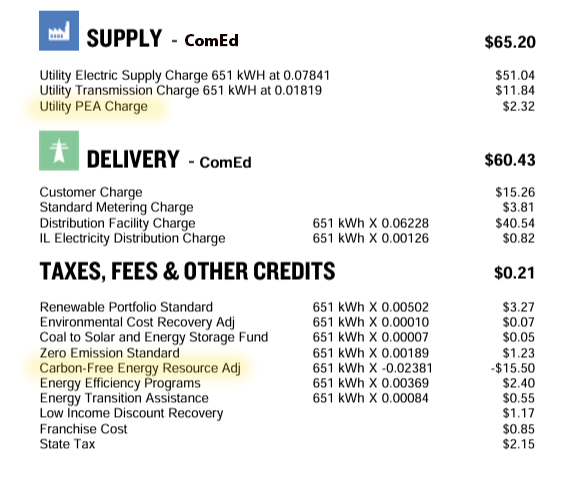
This sample bill shows where you find the PEA and CFERA line items. It does not reflect current rates.
Fortunately, the PEA is expected to drop back to typical levels after May.
What exactly is happening to ComEd bills in May? The Purchased Electricity Adjustment (PEA) is listed as the “Utility PEA Charge” in the “Supply” section of ComEd bills. The Carbon-Free Energy Resource Adjustment (CFERA) is in the “Taxes, Fees & Other Credits” section. Here’s what those line items will be in May:
- For customers on ComEd’s standard rate, the May PEA will be: 8.166 cents per kilowatt-hour (kWh), more than seven times what it was in April. For Hourly Pricing customers, the PEA will be: 8.032 cents per kWh, or more than quadruple what it was in April.
- The Carbon-Free Energy Resource Adjustment (CFERA) will be a credit of 6.144 cents per kWh in May for most customers. (ComEd customers with solar panels, see below.)
How long will this spike in the PEA last?
ComEd says the increase in the PEA will last one month–May only.
What is the PEA?
In Illinois, utilities like ComEd make their money from delivering power to their customers; they do not profit from the electricity supply charge. Electricity supply is bought on the wholesale markets and those costs are passed on to ComEd customers without a markup. For customers who are not with an alternative supplier, the Illinois Power Agency plans and procures power in advance, using hedging strategies to lock in some costs and reduce exposure to market swings. But those forecasts are never perfect, and actual customer usage and wholesale power costs can differ from what was expected. The PEA is the monthly adjustment—either a charge or a credit—that ensures customers ultimately pay the actual cost of supply.
Why is the PEA so high in May?
ComEd said the PEA spiked because the utility had to procure a large amount of electricity in the expensive day-ahead wholesale electricity market during winter storm Fern (January 23-27), a snow and ice storm that hit dozens of states, including Illinois. The per-kWh supply rate collected from customers at that time was lower than what the utility had to pay for the extra power, so the higher PEA in May is largely to collect the difference.
CUB also believes, however, that actions taken at PJM during Winter Storm Fern, in which the grid operator pledged extra customer payments to power plant owners, may have unjustly impacted Illinois consumers.
The PEA is expected to drop to more typical levels–it’s been a charge or credit of less than 2 cents per kWh–after May.
Why is the CFERA a large credit in May?
The Carbon-Free Energy Resource Adjustment (CFERA), created by the Climate and Equitable Jobs Act (CEJA), is meant to be a charge that supports nuclear power plants. However, consumer advocates, including CUB, pushed for a provision that turns the charge into a credit for most customers when energy prices reach a certain high level, such as now.
Energy prices have been elevated due to soaring energy demand from new and proposed data centers. The credit has been even higher so far this year because of Inflation Reduction Act tax credits that were issued to nuclear generators. Under CEJA, a tax windfall like this must be shared with utility customers. The Winter Storm Fern-related wholesale market price spike was yet another windfall for these same generators, so the nuclear generators have to give that money back to customers, too, and that refund is showing up this May.
So what does all this mean for ComEd customers?
Here’s a comparison of customer costs for ComEd’s standard supply price, April vs. May, accounting for ComEd’s price to compare, the PEA and the CFERA:
Supply costs, April:
9.66 cents per kWh (ComEd’s price to compare) + 1.159 cents per kWh (PEA) – 3.186 cents per kWh (CFERA) = 7.633 cents per kWh
Supply costs, May:
9.66 cents per kWh (ComEd’s price to compare) + 8.166 cents per kWh (PEA) – 6.144 cents per kWh (CFERA) = 11.682 cents per kWh
Cost of 500 kWh of electricity in April: $38.17
Cost of 500 kWh of electricity in May: $58.41
This is a 53 percent increase over what customers paid for supply in April. It could have been even worse: Without the CEJA credit, the price would have been nearly 18 cents per kWh.
What can ComEd customers do?
There’s nothing you can do to reduce the PEA in May, unfortunately. But there are some actions you can take to soften the blow of the increase over the month.
- Use efficiency measures to safely lessen energy usage as much as possible in May. Get tips at CUBHelpCenter.com.
- If you can, hold off for a month on any major purchases or activities that may increase your electricity usage.
Do customers with alternative suppliers pay the PEA?
Because they purchase electricity from a company other than ComEd, people with alternative suppliers don’t pay a PEA-but that is no reason to switch to an alternative supplier. Beware of alternative supplier pitches that try to lure you into bad deals. Remember, the PEA spike is one month–only in May. For the most part, alternative supplier offers have been money-losers for consumers: CUB research has shown that Illinoisans have lost more than $2 billion to electricity suppliers over the last 10 years.
What if my home has solar panels?
For solar customers, the CFERA is always the reverse of what it is for other customers. So, if standard customers receive a credit, like they are in May, solar customers will unfortunately receive a charge, and vice-versa. This has to do with the fact that solar customers are generating their own power.
So who’s to blame?
ComEd may not be making money off this increase, but as volatile weather and wholesale market swings become more common, it is clear that the utility–and regulators–need to adapt our state’s supply- and demand-side programs, along with power market hedging policies, to better protect customers.
Later this year, the state of Illinois will embark on its first Integrated Resource Planning Process (IRP), set up by the recently-passed Clean and Reliable Grid Affordability Act (CRGA). CUB will be pushing hard in the IRP for commonsense, lowest-cost solutions to our power system challenges.
Meanwhile, one group that did profit from Winter Storm Fern was big power generators, and that brings us to PJM Interconnection, the power grid operator for northern Illinois and a dozen other states. Poor PJM policies also share blame for volatility in the market. CUB’s Consumer for a Better Grid campaign has for years advocated for better policy to more quickly connect clean, affordable resources to the grid and to rein in data center demand.
