
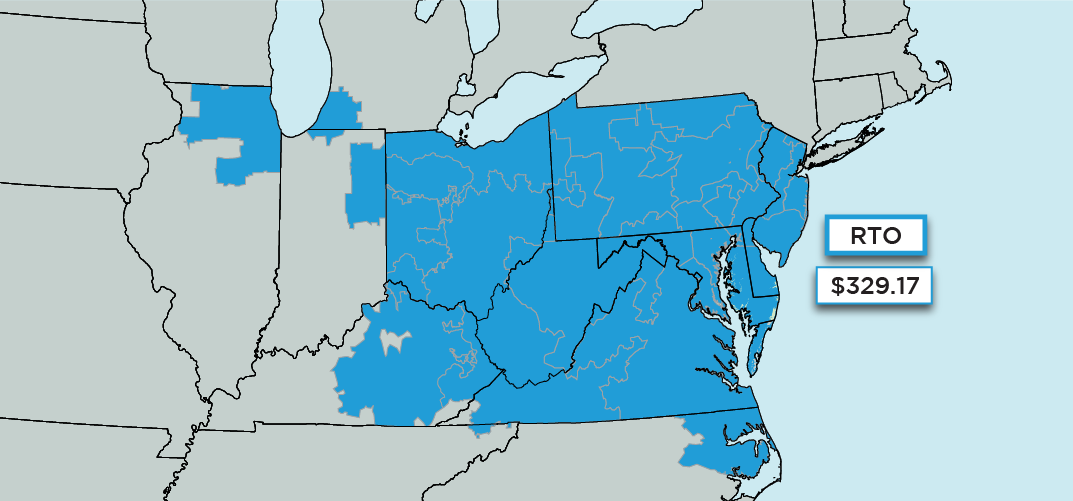
The PJM capacity auction for 2026-2027 led to a price of $329.17 per Megawatt-day, which will keep ComEd’s supply price elevated through May of 2027. Click on the image to read more about the auction results.
Record-high prices in an electricity “capacity auction”–sparked by soaring data center energy demand–have caused Commonwealth Edison’s electricity price to remain elevated for a second straight summer.
ComEd estimates this could cost customers about 12 percent more, on average, from June 2026 through May 2027, but hotter weather and other factors that increase usage could make the impact much higher for customers.
Read CUB’s Q&A below and visit CUBHelpCenter.com for more information.
What is ComEd’s price?
From October 2026 through May 2027, ComEd is charging: 10.103 cents per kilowatt-hour (kWh).
That’s about 53 percent higher from two years ago. Prices are expected to remain elevated over the next few years, at least.
Why is ComEd’s price elevated?
This is largely the result of high energy demand caused by new and proposed data centers.
In July 2025, power grid operator PJM Interconnection announced the results of this capacity auction (technically referred to as the “Base Residual Auction”). The auction is how the grid operator secures reserve power in a vast region–including all or parts of 13 states and the District of Columbia–that stretches from the Midwest to the East Coast and includes ComEd’s territory in northern Illinois.
In that auction, covering the 12-month period from June 2026 through May 2027, prices for PJM jumped to $329.17 per megawatt-day, which is about 22 percent higher than the price that was set last year for ComEd territory and about 11 times higher than what the price was two years ago. (Read CUB’s statement and our WatchBlog article on what happened.)
The Independent Market Monitor for PJM said the primary reason for the spike in prices was data center-related energy demand. Unfortunately, high prices are here to stay for at least the next few years. Another capacity auction, held in December 2025, once again led to record capacity prices, meaning ComEd’s price is expected to be elevated at least through May of 2028. (Read CUB’s statement.)
What exactly are capacity costs?
Not only do you pay for the power you use now, but you also pay for power you could use in the future. Capacity refers to extra payments consumers give power plant operators for the commitment to have enough reserve electricity available if demand suddenly spikes. (Think of a hot summer afternoon, when everyone blasts the AC.)
Normally, PJM holds annual auctions to secure capacity prices three years in advance. But PJM got off schedule years ago and July’s auction set the capacity price for the following June, only 11 months in advance. This compressed auction schedule has contributed to PJM’s problems, because it doesn’t give generators enough time to respond to higher demand by building more power plants. So we end up paying higher electric bills without the market having enough time to build more generation.
Where does a capacity price increase appear on my bill?
An increase in capacity prices will affect the supply section of your ComEd bill. For most customers, capacity costs are buried in ComEd’s per-kilowatt-hour (kWh) supply price–it’s one component of the price, typically accounting for roughly 20 percent of supply.
The exception is if you’re a customer of ComEd’s Hourly Pricing program–which charges you a supply price that can change hourly. Hourly Pricing customers see capacity as a separate line item on bills. These customers have seen their “multiplier” go up.
How is the Climate and Equitable Jobs Act (CEJA) providing some relief for ComEd customers?
The cost increase is partly offset by a credit created by Illinois’ Climate and Equitable Jobs Act, or CEJA. That energy law required a line item on ComEd bills called the Carbon Free Energy Resource Adjustment (CFERA), which was designed to subsidize carbon-free energy produced by Illinois nuclear power plants. But under a provision pushed by consumer advocates, this adjustment becomes a bill credit when energy prices go above a certain level, such as during this spike. For example, that credit was roughly a penny per kWh in June 2026. So the impact of the price spike would have been worse without the CEJA credit.
Capitol News Illinois recently reported that under this CEJA provision, ComEd customers have been credited a net of about $1.9 billion since 2022, when it took effect. Unfortunately, this provision ends in May of 2027.
Note: Solar customers who participate in net metering won’t get this credit on their bills. According to ComEd, the “credit or charge for net metering customers is the reverse of what it is for other customers.” So, if standard customers receive a credit, net metering customers receive a charge, and vice-versa. This has to do with the fact that solar customers are generating their own power. However, even with the charge, homes with solar panels should enjoy net savings during high-priced times like this.
So who’s making money off the price spike?
Power generators–large corporations that own power plants, such as Constellation and Vistra, and sell power to utilities like ComEd–are making a killing.
PJM has reported that capacity costs for consumers have jumped in recent auctions, from $2.2 billion, to $14.7 billion, to $16.1 billion in the July 2025 auction that helped determine the current ComEd price . Not only was the capacity expensive, but the majority of it was dirty: 45 percent was gas, 21 percent nuclear, 22 percent coal, with only 3 percent wind and 1 percent solar, Sierra Club reported.
ComEd is not making money off this price spike. The regulated utility passes supply costs–including capacity payments–onto consumers with no markup. (Note: ComEd profits off another part of the bill–the delivery charges–and CUB challenges those increases before the Illinois Commerce Commission [ICC]. However, this supply price spike has nothing to do with ComEd’s delivery rate hikes.)
Why did this happen?
The Independent Market Monitor for PJM said the primary reason for the spike in prices was data center-related energy demand. These large-scale facilities can increase costs for all of us on different levels of the power system, from the local distribution wires, to high-voltage transmission lines, all the way up to big power plants that provide energy and capacity. Each of these is overseen by different combinations of state, regional and federal entities–and policy changes are needed at every level to preserve affordability for Illinoisans.
At PJM: The power grid operator has to reform its policies (Read our blog article: PJM broke the capacity auction–but here’s how they can fix it.) CUB has launched its Consumers for A Better Grid campaign to push for reforms in a number of areas.
- PJM has proposed a data center policy–but questions remain about whether the proposal will actually protect the PJM region’s 67 million electric customers from soaring power bills. PJM plans to hold a special one-time auction in September to serve data centers. In the auction design, PJM must ensure that it only buys capacity for data centers that are financially committed through “buy bids,” rather than based on its flawed load forecasts.
- Data centers that don’t bring their own new capacity should be required to act as flexible load, reducing operations or using on-site backup battery systems when electricity is in high demand to spare the grid. In PJM parlance, this is called “connect and manage.” And critically important: PJM must remove connect and manage data centers from the capacity market, so they don’t drive up prices for the rest of us.
At the federal government: Washington needs to pass strong policy, such as the federal Power for the People Act (S. 3682). This legislation is another piece of the puzzle to ensure that everyday customers are not forced to subsidize the costs of rapid data center expansion. Among other things, the Act would:
- Direct the Federal Energy Regulatory Commission (FERC) to establish rules to ensure that data centers are paying for the local transmission upgrades they are directly causing.
- Require states to consider data center-specific rate classes.
- Set rules that ensure utilities use better information when predicting future electricity needs.
In Illinois: The General Assembly needs to pass commonsense safeguards for data centers. The POWER Act would:
- Require utilities to create new rules to protect their existing customers from subsidizing data center-related upgrades to the distribution and transmission infrastructure.
- Require data centers to bring their own new clean power if they want firm electric service that won’t be curtailed at times of high demand.
- Ensure that any data center-related costs from PJM get passed on to data centers in Illinois, not the rest of us.
How can ComEd customers try to lessen the impact of the supply price increase?
Some steps you can consider to lessen the impact.
- Contact your utility. If you are having trouble affording your energy bills, it is vital that you contact your utility. Find out if you can set up a payment plan to give you a longer time to pay off your bills; and inquire about no or low-cost energy efficiency programs the company offers. Also, consider signing up for ComEd’s Peak Time Savings program, which gives residential customers the opportunity to earn small bill credits by reducing electricity usage during times of high electricity demand, typically summer afternoons.
- See if you qualify for energy assistance. To learn more about the Low Income Home Energy Assistance Program (LIHEAP), visit the state’s special website, www.helpillinoisfamilies.com, or call the Help Illinois Families Assistance Line at 1-833-711-0374.
- Practice energy efficiency. For tips and information about helpful ComEd energy efficiency programs, visit CUB’s Clean Energy page and ComEd’s energy efficiency page.
- Consider a community solar deal to help ease costs. Community solar offers currently guarantee savings compared to the utility’s supply price. But be a careful shopper: Get more information at our special website, SolarInTheCommunity.com.
- If you’re interested in installing solar panels, consider the next steps. Learn more about the Switch Together program, which CUB participates in, and rooftop solar in general. Also, there is an excellent program for income-qualified customers interested in solar called Illinois Solar for All.
- Beware of bad alternative supplier deals. Alternative supplier sales representatives pitching you via door-to-door, phone or mail marketing may try to use this impending price increase to lure you into a bad deal. Remember: Alternative supplier prices will also go up because of the increase in capacity prices. Illinois electric customers have lost about $2 billion to alternative electric suppliers over the last decade. Even in this market, it’s likely ComEd is your best bet for electricity supply. If your community has a “municipal aggregation deal,” in which community leaders negotiate with an alternative supplier to try to secure a reasonable electricity price, don’t assume the community power deal will save you money–savings aren’t guaranteed. Make an apples-to-apples comparison between the aggregation offer’s price and your utility’s supply rate, and find out when the aggregation offer expires. See CUB’s fact sheet on community power deals, and see this list of community deals from the ICC.
Are Ameren Illinois customers impacted by capacity prices?
Yes. Ameren Illinois’ capacity market is run by a different power grid operator, called the Midcontinent Independent System Operator, or MISO. The prices in MISO’s auction also have skyrocketed.
This article is part of CUB’s Consumers for a Better Grid campaign. Sign up here to get alerts for campaign news.
